What Is Welding Automation?
Welding automation is the use of mechanized or robotic systems to perform welding operations with controlled, repeatable motion — replacing or augmenting manual welding to deliver consistent weld quality at higher speeds and lower per-part costs. In industrial manufacturing, welding automation spans a wide range of processes: submerged arc welding (SAW), MIG/GMAW, TIG/GTAW, plasma welding, and flux-cored arc welding (FCAW), each suited to different materials, joint configurations, and deposition requirements.
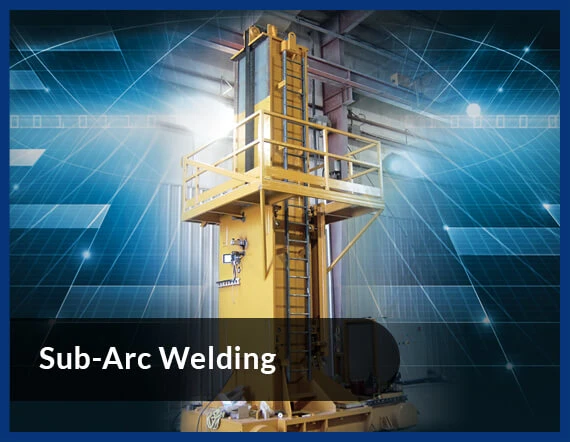
BP Automation engineers custom welding automation systems in Edmonton, Alberta, for manufacturers across Western Canada who need weld quality, throughput, and consistency that manual welding cannot reliably deliver at scale. Submerged arc welding automation is one of our core capabilities — high-deposition, high-quality, and highly repeatable for the applications that demand it.
Why Automate Submerged Arc Welding?
Submerged arc welding produces some of the highest-quality, highest-deposition welds in industrial manufacturing — but manual SAW is slow to set up, difficult to control on large workpieces, and limited by the physical reach and endurance of the operator. Automated SAW systems remove those constraints: the machine travels the joint at a controlled speed, maintains arc length and wire feed, and delivers consistent parameters across the full length of every weld, every time.
For high-volume applications like pressure vessel fabrication, pipe cladding, structural plate welding, and heavy component manufacturing, welding automation via SAW delivers deposition rates and quality consistency that no manual welding process can match at scale.
Welding Automation Applications We Build For
Pressure Vessel Fabrication
Longitudinal and circumferential seam welding with controlled heat input and consistent penetration for ASME and CWB-certified production.
Pipe Cladding & Overlay
Internal and external pipe cladding using automated SAW or open arc for corrosion-resistant and wear-resistant overlay applications.
Structural Steel & Plate
High-deposition welding of thick plate, I-beams, box sections, and structural weldments where manual welding is too slow or inconsistent.
Heavy Equipment Components
Mining, forestry, and construction equipment parts welded automatically for strength, toughness, and consistent production throughput.
Panel & Flat Weldments
Automated panel welding for flat plates, floor sections, and bulkhead assemblies where long straight-seam welds need speed and consistency.
Multi-Wire SAW Systems
Twin-wire and tandem SAW configurations for maximum deposition rates on high-volume production of thick-section weldments.
What a Custom SAW Automation System Includes
BP Automation’s submerged arc welding systems are fully engineered solutions — not just a welding head on a track. A typical custom SAW automation system from BP Automation includes:
- Column-and-boom or gantry structure sized to your workpiece
- Motorized cross-travel and vertical axes with precision speed control
- Wire feed system with tachometer feedback and wire straightener
- Flux hopper, delivery system, and flux recovery where applicable
- PLC-based control with HMI for parameter setting, monitoring, and data logging
- Seam tracking or joint sensing for consistent arc positioning
- Integration with your positioner, rotator, or part handling system
Welding Automation That Fits Your Operation
Every welding automation project starts with your production problem — the joint, the material, the volume, the quality standard, and the floor space. We engineer the system around those requirements. Whether you need a simple mechanized welding carriage or a full multi-axis SAW cell with integrated part handling, BP Automation designs, builds, installs, and commissions the system so it’s running correctly from day one.