What Is Robotic Automation in Manufacturing?
Robotic automation in manufacturing refers to the integration of industrial robots into production processes to perform tasks — welding, cutting, handling, assembly, inspection — with speed, precision, and repeatability that manual labour cannot consistently match. Unlike fixed automation, robots are programmable: they can be retooled for different parts, paths, and processes as your production requirements change.
BP Automation designs and builds custom robotic automation systems in Edmonton, Alberta, for manufacturers across Western Canada. We don’t sell standard robot cells off a spec sheet — we engineer the complete system around your application: your parts, your floor layout, your throughput requirements, and your integration with upstream and downstream processes.
Robotic Automation vs. Fixed Automation
Fixed automation — like a dedicated welding carriage or a single-axis cladding machine — is highly efficient for one specific task on one specific part. Robotic automation adds flexibility: a robot arm with the right end-of-arm tooling can handle multiple part variants, reach complex geometries, and be reprogrammed as products evolve.
The right choice depends on your production mix. High-volume, single-part applications often favour fixed automation for its simplicity and speed. Mixed-part or higher-variety production lines benefit from the flexibility of robotics. BP Automation helps you make that call based on your actual production data — and can integrate both into a single cell when needed.
Robotic Automation Applications We Build
Robotic Welding Cells
MIG, TIG, and plasma welding automation with robot-mounted torches, servo positioners, and seam tracking for consistent weld quality.
Robotic Material Handling
Automated loading, unloading, and transfer between machines — reducing manual handling and keeping production lines moving without bottlenecks.
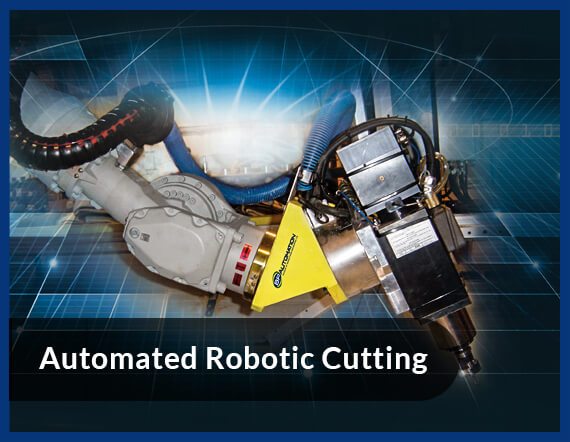
Robotic Cutting
Multi-axis robotic plasma or laser cutting for 3D profiles, trim operations, and complex part geometries that fixed-axis machines can’t reach.
Robotic Inspection
Vision-guided robotic inspection cells for dimensional verification, surface inspection, and automated quality data collection.
Collaborative Robots (Cobots)
Human-robot collaborative cells for assembly, pick-and-place, and light manufacturing tasks where operators and robots share the workspace safely.
Multi-Process Robotic Cells
Integrated cells combining welding, grinding, cutting, and handling in a single automated workflow — reducing part touches and floor space.
Industries We Build Robotic Systems For
- Oil & gas — robotic welding of pressure vessels, pipe spools, and structural components
- Mining — automated hardfacing, handling of large wear components, and robotic inspection
- Food processing — hygienic robotic handling, filling, portioning, and packaging automation
- Structural fabrication — robotic welding of beams, frames, and custom structures at scale
- General manufacturing — flexible robotic cells for mixed-part production and assembly
What BP Automation Delivers — Not Just a Robot
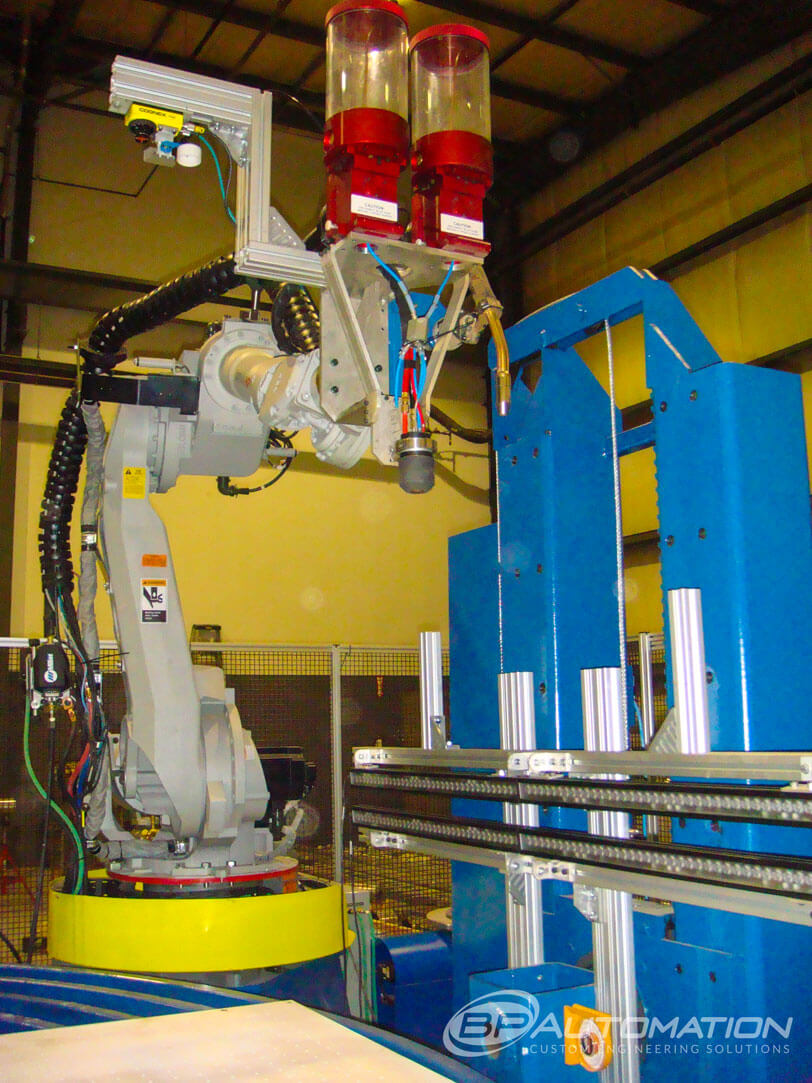
Buying a robot arm is the easy part. Making it work reliably in your production environment — with the right tooling, safety systems, programming, and integration into your workflow — is where most automation projects succeed or fail. BP Automation delivers the complete engineered system: mechanical design, end-of-arm tooling, fixturing, safety guarding, PLC and robot programming, commissioning, and operator training.
We work with major robot brands and select the platform that best fits your application — not the one that’s easiest for us. The result is a robotic automation system that runs reliably, is maintainable by your team, and delivers the throughput and quality you need from day one.